
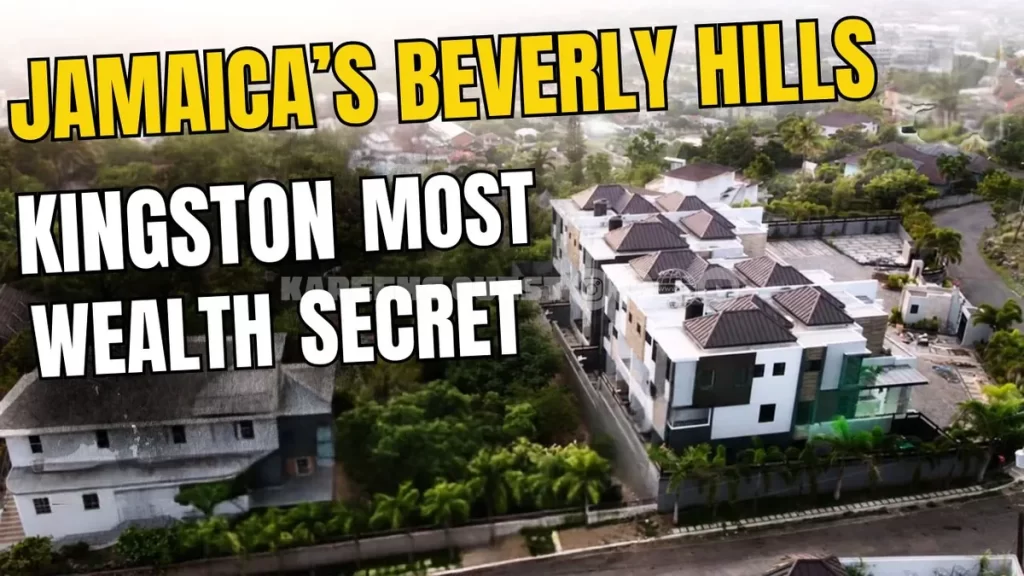
Driving up the winding incline of Old Hope Road into the elevated pockets of St. Andrew offers an immediate shift in atmosphere. The dense sound of traffic, street vendors, and city buses gives way to cool hillside air and wide, quiet streets overlooking Kingston Harbour. Beverly Hills once stood as one of the most visible architectural statements of status in Jamaica. Understanding how this hillside residential enclave came to be requires looking back to Jamaica’s post-independence era, the economic and political shifts of the 1970s and 1980s, and the desire for physical elevation above the city below.
Truth be told, this is the first time I have ventured to this section of the parish. I usually go the opposite end towards Albert Town.
Watch my full video of this villa at the bottom of the article
The Historical Anchor & 1960s Genesis
Long before concrete foundations and multi-story balconies lined these ridges, the terrain formed part of the rugged Liguanea Plain foothills and Long Mountain. Archaeological studies in the Mona and Beverly Hills hillsides revealed significant Taino indigenous settlement sites that predated colonial-era estate boundaries by centuries.
The neighbourhood took form around Jamaica’s independence in 1962. Developers executed a civil engineering effort that involved blasting roads directly into steep limestone rock faces. Named explicitly after Beverly Hills, California, the subdivision was planned as a residential community for the island’s emerging successful professionals alongside established merchant families.
This residential expansion coincided with broader national economic growth. Between 1962 and 1972, a massive bauxite and alumina mining boom positioned Jamaica as a global raw-material producer. Foreign direct investment accelerated hotel development, high-rise office construction in New Kingston, and urban expansion, driving a sharp increase in white-collar employment across the capital. Backed by government incentives, local manufacturing expanded to supply domestic consumer goods, shifting commercial focus away from traditional import trading into formal corporate sectors.
The Socio-Economic Parallel (Why Scale the Mountain?)
Moving to Beverly Hills was never simply a real estate purchase; it functioned as a visual marker of social mobility and achievement in Jamaican society. In local culture, “living on the hill” established a distinct boundary between the bustling commercial flatlands below and the residential tranquility above.
“The experience here is more unique when compared to a hotel. You can design your meal and drink menu to suit your budget and taste, plus you are not sharing the space with hundreds of other persons at the same time,” revealed Hudson.
Political Upheaval, Mass Exodus, and Market Shifts
The late 1980s brought severe political turmoil, currency devaluations, and economic instability across Jamaica. This volatile environment triggered a mass exodus of wealthy families, business proprietors, and professionals who chose to migrate, primarily to the United States.
Uncertain about the island’s future and eager to liquidate assets quickly, many Beverly Hills homeowners put their properties on the market at heavily discounted prices. This sudden wave of panic selling temporarily depressed real estate values in the area. However, it also opened doors for a new wave of local buyers, investors, and returnees who acquired prime hillside land at below-market rates, setting the stage for the neighborhood’s subsequent transformation.
Architectural Evolution & Market Valuation
The architectural footprint of Beverly Hills has transformed substantially over the decades. Initial 1960s construction consisted primarily of modest, mid-century modern bungalows designed with wide eaves, louvers, and open verandas to capture natural mountain airflow and city views. Over time—and particularly as new owners acquired properties following the 1980s exodus—many of these original structures were renovated or replaced by multi-story contemporary homes with high security perimeter walls, gated entryways, and expansive balconies.
During the 1970s, a standard home in the neighbourhood could commanded between JMD $30,000 and $60,000, aligning with post-independence real estate figures. Today, modernized estates and multi-story luxury properties list anywhere from JMD $150 million to over JMD $600 million (approximately $1 million to $3+ million USD), maintaining its rank among the premier real estate addresses in St. Andrew.
Planning a visit to Kingston or exploring regional destinations across the parish? Download our detailed travel booklet, Explore Jamaica, for comprehensive guides, cultural background, and logistical recommendations to help organize your itinerary.

Essential Travel Logistics & Guides
When coordinating visits to cultural sites, heritage locations, or regional tours throughout Kingston and neighbouring parishes, booking reliable transport and accommodation early ensures a smoother experience. You can research verified stays and local tour options using trusted partners:
- Browse top-rated accommodation listings on TripAdvisor
- Book guided heritage and sightseeing excursions through Viator.
- Stay connected on the road with instant mobile data using an Airalo eSIM.
For additional regional guides and cultural stories across the island, check out our insights on Rafting on the Rio Grande, explore mountain retreats like Jay’s Guest House in Epping Farm, or read our local dining reviews at Grego’s Seafood Bar & Grill.
Frequently Asked Questions
Where is Beverly Hills located in Jamaica?
Beverly Hills is an elevated residential neighbourhood situated on the slopes of Long Mountain in the parish of St. Andrew, directly overlooking the city of Kingston and Kingston Harbour.
When was Beverly Hills developed?
The neighbourhood was carved out and developed in 1962, coinciding directly with Jamaica’s independence. Roads were engineered into the limestone hillsides to establish an exclusive residential suburb.
How did political upheaval in the 1980s affect Beverly Hills real estate?
Widespread political instability led to a mass exodus of families migrating to the United States. Many homeowners sold their properties for below market value to facilitate quick relocations, allowing new buyers and investors to purchase prime hillside land cheaply before values rebounded.
What is the average cost of a home in Beverly Hills, Jamaica?
While 1970s homes were valued between JMD $30,000 and $60,000, current property values for luxury estates generally range from JMD $150 million to over JMD $600 million (USD $1 million to $3+ million) depending on land size, modern amenities, and harbour views.
Watch the latest Kareem’s Quest Podcast videos on YouTube, click the link below