
When I travel the world, I am constantly struck by how many people are fascinated by Port Royal. It’s hard for some to grasp now, but in its prime, this spit of land was the New York or London of its era—a massive commercial engine and a global center of influence.

A few years ago, I found myself watching the STARZ series Black Sails. The show captures the grit and scale of 17th-century Port Royal, portraying it as a place where the air was thick with the scent of sea salt, expensive spices, and unrefined sugar. Seeing those bustling streets on screen brought to life the reality of a town that was once the virtual capital of Jamaica and a hub of unimaginable wealth.
Today, my relationship with the town is much more grounded. It is the place I go to enjoy a plate of escovitch fish at Gloria’s Seafood. There is a specific quietness to the modern fishing village that makes the weight of its history feel even heavier.

The Wickedest City on Earth
In the 1600s, Port Royal was the headquarters for the “Brethren of the Coast.” It was the richest English city in the Americas, built on a foundation of Spanish plunder. The culture was defined by excess; accounts suggest there was a tavern or brothel for every four buildings. It was a port and a sanctuary for privateers and buccaneers who operated with the blessing of the British Crown to harass Spanish shipping lanes.
The streets were walked by legendary figures like Sir Henry Morgan, who eventually traded his pirate’s life for a role as Lieutenant Governor. Others, like Calico Jack Rackham, Anne Bonny, and Mary Read, cemented the city’s reputation for lawlessness. Even the infamous Blackbeard had ties to these shores. The wealth flowing through the harbor was so immense that it drew merchants and craftsmen from across the globe, creating a dense urban center that rivaled the great cities of Europe.
The 1692 Earthquake
The era of debauchery came to a sudden, violent halt. On June 7, 1692, at approximately 11:43 AM, a massive earthquake and subsequent tsunami struck the peninsula. In just a few minutes, two-thirds of the city slid into the sea. Many survivors viewed the disaster as a literal act of “God’s punishment” for the town’s perceived sins.
What remains today is often called the “Sunken Pirate City.” It is a protected underwater heritage site where history is frozen beneath the waves. During archaeological expeditions led by Edwin Link in 1959, divers recovered a pocket watch with its hands stopped at the exact time of the quake. They found intact house structures, cannons, and pottery—a preservation level so high that Port Royal is now considered one of the most important archaeological sites in the Western Hemisphere. While the sunken ruins are restricted to licensed tours, you can stand at Nelson’s Quarterdeck at Fort Charles and look out over the water, knowing an entire 17th-century world lies just beneath the surface.
Walking Through History
Walking through the town today, the architecture still whispers stories of the past. The wooden infrastructure of the older houses remains remarkably consistent with the original styles, maintaining an aura that feels disconnected from the modern world.
Key Historic Sites:
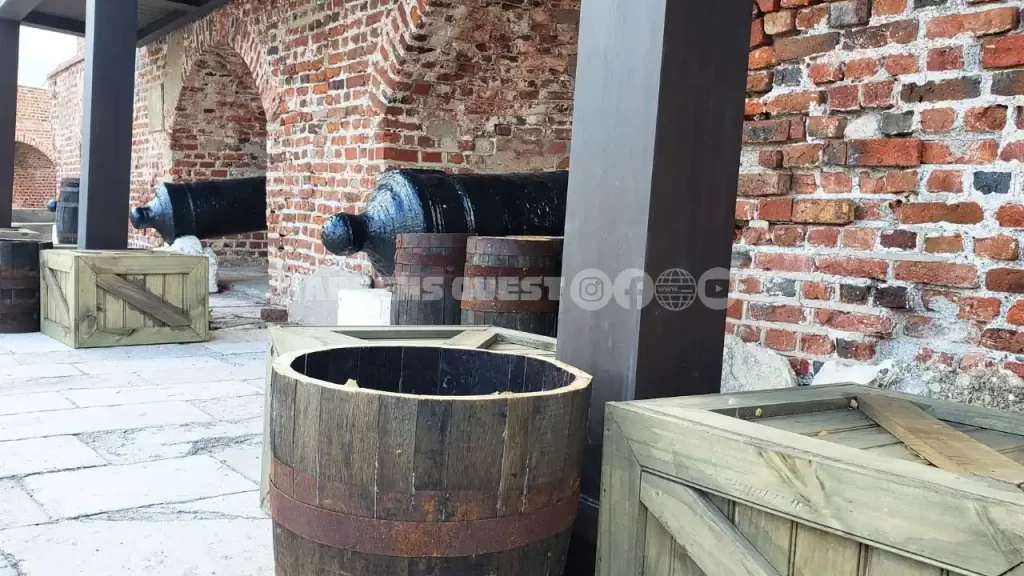
- Fort Charles: Built in 1656, this is the oldest fort in Jamaica. It survived the 1692 disaster and served as a strategic base for Admiral Horatio Nelson. You can still see the rows of cannons pointing out toward the Caribbean Sea.
- The Giddy House: Originally a Royal Artillery Store built in 1888, the 1907 earthquake tilted this building at a 45-degree angle. Walking inside is a disorienting experience; the slant plays tricks on your inner ear, making you feel instantly “giddy” or dizzy.
- St. Peter’s Anglican Church: Though the original was lost in 1692, the current structure dates back to 1726 and houses artifacts from the pirate era.
- The Naval Hospital: A rare 19th-century building constructed using prefabricated cast iron imported from England.
Seafood and Sun
For many locals, the draw to Port Royal isn’t just the ghosts of pirates, but the food. Gloria’s remains a culinary landmark. There is nothing quite like sitting on the upper deck, feeling the sea breeze, and tearing into a piece of bammy.
If you want to escape the mainland entirely, you can take a boat out to Lime Cay, a beautiful white-sand offshore cay. Many visitors book tours through Loose Canon, which offers catamaran cruises that depart from the nearby hotel docks.
Back in the day, a ferry used to transport people directly from Kingston to Port Royal. It was an exciting way to approach the town, seeing the fortifications grow larger as you neared the peninsula. While that regular service has seen changes over the decades, the journey to Port Royal—whether by boat or by the long road along the Palisadoes—always feels like a transition into another era.
A UNESCO Legacy and Pop Culture
On July 12, 2025, the “Archaeological Ensemble of 17th Century Port Royal” was officially inscribed on the UNESCO World Heritage List. This designation recognises its “Outstanding Universal Value” as a uniquely preserved terrestrial and submerged site.
Its legendary status has also made it a staple in the film industry. From the high-seas adventure of Pirates of the Caribbean to the gritty realism of Black Sails, Port Royal continues to capture the global imagination. It has transformed from the “wickedest city” into a quiet, culturally significant destination that guards the secrets of Jamaica’s maritime history.