
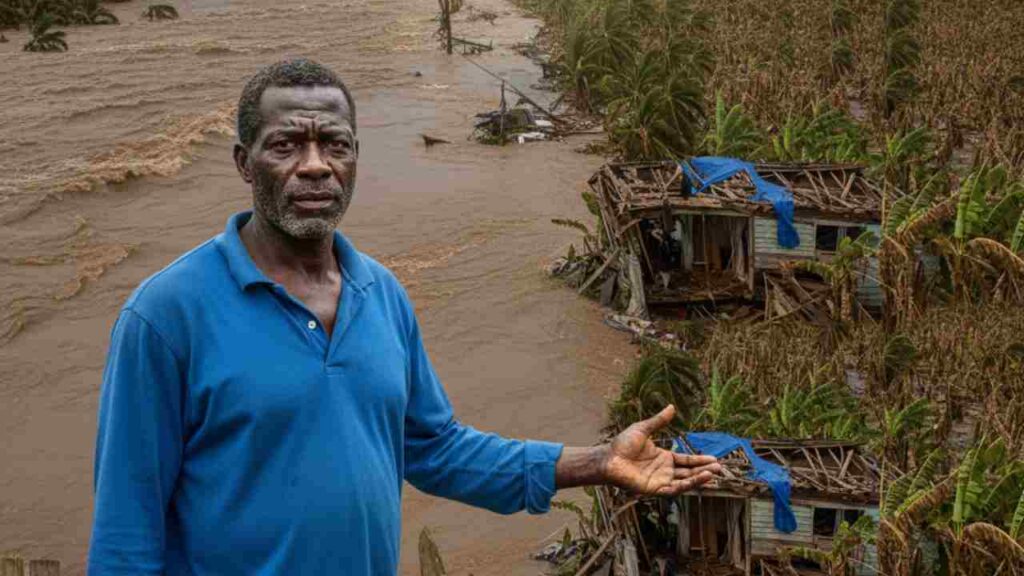
The passage of Category 5 Hurricane Melissa has delivered a catastrophic financial shock to Jamaica, triggering an urgent reassessment of national infrastructure and long-term fiscal planning. As the country transitions from immediate rescue to preliminary recovery, official estimates confirm a multi-billion-dollar cost that will dominate economic policy for the coming fiscal year. The scale of the destruction has prompted comparisons to previous national crises, such as the destructive path carved by Hurricane Ivan.
Coastal communities, particularly those in Westmoreland and the tourism center of Treasure Beach, are reporting unprecedented infrastructure damage.For a detailed review of the local impact, see the reports on Hurricane Melissa’s True Cost in Westmoreland, Jamaica and the initial assessment of the impact on Category 5 Hurricane Melissa Flattens Treasure Beach Hotels.
Sectoral Damages and the Staggering Financial Toll
In a statement to Parliament, Prime Minister Dr. Andrew Holness presented a preliminary estimate of the damage to physical infrastructure. Based on benchmarks from comparable regional disasters, the impact is estimated at between US$6 billion (J$963 billion) and US$7 billion (J$1.1 trillion), a figure equivalent to 28 per cent to 32 per cent of the GDP for the fiscal year 2024-2025. The Prime Minister noted that this devastation is projected to cause a decline in short-term economic output by eight to 13 per cent.
The scope of this financial devastation extends across all critical sectors. The country’s infrastructure—spanning housing, water, electricity, telecommunications, and roads—has sustained severe losses. At least one economist, Keenan Falconer, has indicated that the total cost could potentially reach an estimated US$16 billion (J$2.5 trillion) or up to at least 75 per cent of gross domestic product (GDP), according to reporting by The Jamaica Gleaner.
Infrastructure and Livelihoods Decimated
Physical damage is evident in every parish. Major arterial roads and secondary thoroughfares have been severed by landslides and flooding, complicating initial relief efforts. Residential losses are widespread, with thousands of houses sustaining partial or total collapse, particularly in vulnerable low-lying areas. Furthermore, the extensive damage to the national water pipeline system has crippled distribution networks, leading to a humanitarian crisis of access to potable water in several parishes.
The critical agricultural sector has been one of the hardest hit. The Jamaica Information Service stated that preliminary estimates from the Ministry of Agriculture, Fisheries and Mining indicate over $20 billion in losses to the agriculture and fisheries sectors following Hurricane Melissa. The southern parishes, notably St. Elizabeth, which serves as the island’s primary food source, have reported near-total crop loss for staples like vegetables and ground provisions. This destruction highlights the magnitude of the economic blow documented in earlier analyses of Hurricane Melissa’s Wrath on Jamaica. The loss of crops and livestock will have immediate effects on food security and sustained inflation.
Activating Jamaica’s Financial Shield
Amidst the massive financial challenge, attention has turned to the Catastrophe Bond (Cat Bond), a core component of the country’s modern financial resilience strategy.
As one of the most exposed countries to natural disasters, Jamaica has a well-developed disaster risk financing strategy. This strategy includes catastrophe insurance coverage with the World Bank (International Bank for Reconstruction and Development, IBRD), backed by a Cat Bond issued in 2024, which renewed a previous 2021 bond. Former Minister of Finance and the Public Service Dr. Nigel Clarke championed this mechanism, designed to provide rapid, predetermined financing following a major natural disaster, thereby reducing dependence on debt-accruing emergency loans.

Following Category 5 Hurricane Melissa, the World Bank confirmed the government would receive a full payout of $150 million under this coverage. The payout was triggered after analysis carried out by the third-party calculation agent, AIR Worldwide Corporation, concluded that the hurricane reached the pre-agreed parametric triggers. This analysis was based specifically on the storm’s central pressure and path, as reported by the National Hurricane Center. This immediate liquidity is critical, allowing the government to bypass lengthy assessment periods and quickly inject funds into essential infrastructure restoration.
The aftermath of Category 5 Hurricane Melissa represents one of the most significant challenges to Jamaica’s economic stability in a generation, demanding both immediate international aid and sustained, resilient investment.
To find out how you can help visit: https://supportjamaica.gov.jm/
What critical area do you think should be Jamaica’s absolute priority for rebuilding right now: roads, housing, or the agriculture sector?
Share your thoughts in the comment section below.