
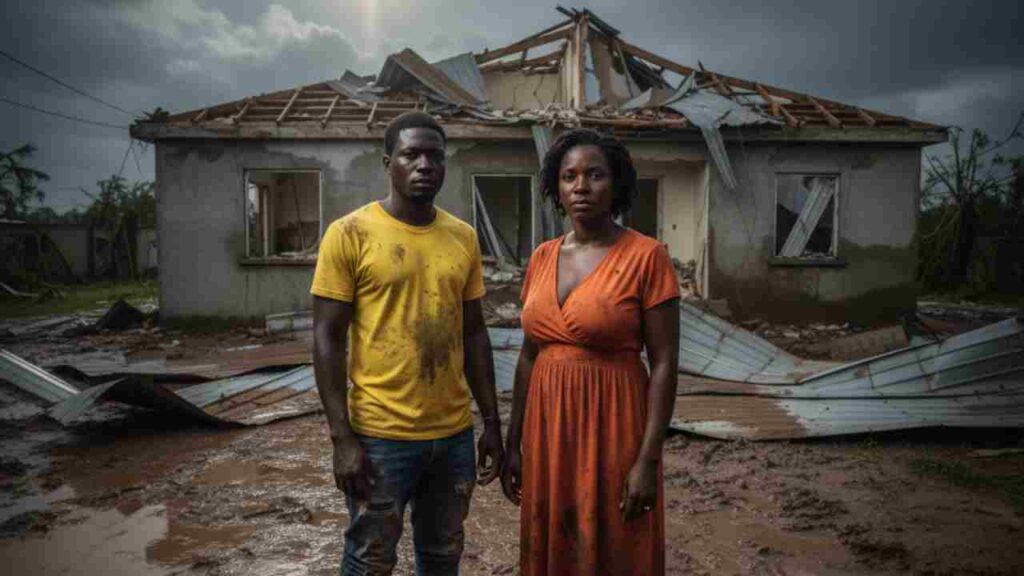
The parish of St. James, a major economic and urban centre, is contending with a dual crisis in the aftermath of Category 5 Hurricane Melissa: widespread structural failures in recently constructed housing and a rapidly deteriorating public health environment caused by extreme flooding. The twin challenges have placed immense strain on residents and local authorities attempting to stabilize the western region.
Housing Development Failures Trigger Outrage
At Edmund Ridge Estates in Rhyne Park, Montego Bay, a government-partnered housing scheme completed just three years ago, outrage has surfaced among homeowners. Despite paying significant sums—upwards of $19.2 million for some units—residents witnessed catastrophic structural failures during the hurricane’s passage, leaving numerous families displaced.
Homeowners are urgently demanding an investigation into the building standards and certification processes for the development, a collaborative project between the Housing Agency of Jamaica (HAJ) and the Chinese firm Henan Fifth Construction Group.
Concerns about construction quality predate the hurricane. Maurice McGhie, a Phase 2 homeowner, told The Sunday Gleaner that residents had noticed “significant” flaws, including leaky windows and seeping walls, upon moving in. The hurricane’s fierce winds removed roofs from an estimated more than 90 per cent of units in Phase 2, with interior drywall in some homes crumbling completely.
McGhie described his family’s traumatic experience:
“When the zinc was flying away, I asked him to go under the bed, and that’s where we sought cover. When the roof was going, we run out of it, and that’s what spared our lives. He was crying, traumatised,” he shared with The Sunday Gleaner, adding that he and his wife were forced to sleep in their car.
Another resident, Marie McIntyre, who returned from the United Kingdom to invest in the scheme, expressed deep regret over the quality: “It’s going to need a roof. The walls are plaster boards… I have paid for a house and now I’m going to have to rebuild it. I’m surprised that the specs for these houses were as they are.”
HAJ Managing Director Doreen Prendergast acknowledged the agency’s “empathy” but defended the certification process when contacted by The Sunday Gleaner, stating: “I cannot sit here and surmise that whatever roofing can withstand a Category 5 hurricane. What I know is that we are doing this housing development and there are professionals undertaking this development.”
Contaminated Mud Creates Health Hazard
While wind damage devastated new housing, torrential rain led to widespread flooding in older, low-lying communities near Montego Bay. Areas like Westgreen and Catherine Hall were inundated by floodwaters, which, upon receding, left behind a pervasive layer of thick, contaminated mud and silt.
The issue is not just inconvenience; it is a critical public health emergency. Contaminated sewage overflowing into the floodwaters mixed with the sludge, creating a breeding ground for diseases.
Residents report immediate health issues. Nicólee Wynter, a community member, described the scene to The Sunday Gleaner: “The smell is suffocating… Mostly rats and cats are in the water, and dogs – dead dogs! Right now, people ‘round here start scratch them skin. Disease start come out likkle by likkle.”
Seventy-seven-year-old John Lee, a retired firefighter, paused while trudging through the muck to express his concern about the worsening conditions:
“Mud and everything – that’s what we’re living in now. Mi face a scratch mi, y’know, ‘cause mi haffi up and dung inna di mud,” he said wearily to The Sunday Gleaner.
Public health officials are sounding an alarm. Michael Williams, director of environmental health in the Ministry of Health and Wellness, warned The Sunday Gleaner that the environmental hazards could trigger outbreaks of water- and vector-borne diseases like leptospirosis, dengue fever, and gastroenteritis. The Ministry has observed an uptick in gastroenteritis cases already and is responding by setting up field hospitals, including a planned unit at Cornwall Regional Hospital in Montego Bay.

Mayor Richard Vernon confirmed to The Sunday Gleaner that cleanup efforts in Westgreen and Catherine Hall, involving trucks and heavy machinery, began shortly after the hurricane, but the sheer volume of debris requires sustained effort.
Despite the difficult conditions, aid is mobilizing. The St. James Municipal Corporation, the Public Health Department, and humanitarian partners are working to clear debris, distribute disinfectant, and collect water samples for testing to safeguard against contaminated sources. “This will be a substantial undertaking, and it will take time to get an accurate read on the scope,” he stated to JIS.
The twin challenges in St. James—the need for structural accountability and the fight against a looming health crisis—underscore the complex and sustained recovery required across western Jamaica following the devastating impact of Category 5 Hurricane Melissa.
To find out how you can help visit: https://supportjamaica.gov.jm/
Considering the simultaneous crises of structural failure and public health risk in St. James, which problem do you believe demands the immediate, highest priority of government resources right now?
Share your thoughts in the comment section below.