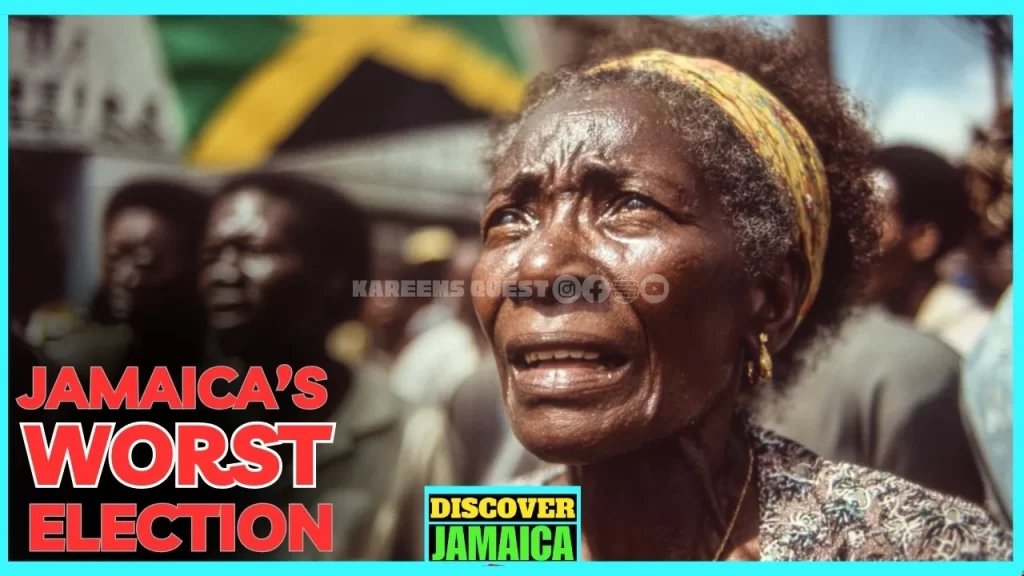
Jamaica, a nation just eighteen years into its independent journey, grappled with forging its economic and political identity as the 1980s dawned. The air was thick with a global chill, the Cold War casting its long shadow. With close proximity to Cuba, a communist ally, Jamaica found itself a stage for ideological clashes between socialism and capitalism. This intense international climate magnified the internal struggles for the young nation.
Full Video Podcast discussion of this topic at the end of the article
The island’s economic heart, downtown Kingston, a bustling hub of businesses and vital ports, became the epicenter of much of the civil unrest. The pressure cooker atmosphere extended beyond the political arena, touching even the cultural icons. In 1976, an assassination attempt on Bob Marley was widely linked to the escalating political tensions. In a poignant gesture of peace, Marley returned from exile to headline the One Love Concert in 1978. On that iconic night, he famously joined the hands of the opposing political leaders, a powerful symbol of unity. Yet, this fragile peace proved short-lived as the violence leading up to the 1980 election intensified.

The Defining Roar of 1980
Jamaica’s first election as an independent nation took place on April 10, 1962, setting the stage for decades of democratic process. However, the 1980 Jamaican General Election stands as a singular, often somber, chapter in the island’s history. The electoral climate was charged, a landscape of fervent loyalties and deep divisions.
One of the most striking and tragic stories to emerge from this period centered on Roy McGann. A People’s National Party (PNP) politician, McGann served as a Member of Parliament for St. Andrew parish and held the position of Deputy National Security Minister. Despite his brother being aligned with the rival Jamaica Labour Party (JLP), McGann was deeply committed to his political cause and his community, even operating a chicken and egg farm.
On October 14, 1980, while campaigning for reelection, McGann and his entourage traveled to Gordon Town square. What followed was a brutal shootout involving the police, claiming the lives of McGann and his bodyguard. The incident sent shockwaves across the island. His replacement as a candidate, Lloyd ‘Perry’ Stultz, ultimately lost the seat to Joan Webley.
Other Moments Etched in Memory
The 1980 election was marked by several other notable, and often tragic, events:
- Lives Lost: Over 800 lives were reportedly lost due to political upheaval during this period.1
- The Eventide Home Fire: On May 20, 1980, a devastating fire erupted at the Eventide Home for the Aged, a state-run facility for elderly and destitute women in Kingston.2 The fire tragically killed at least 153 women, with some reports citing 157 deaths and 14 missing.3 Many of the victims were burned beyond recognition. The cause of the fire was widely debated, with allegations of arson linked to the political climate.4
Beyond the intensity of 1980, other elections have offered their own memorable moments:
- Father vs. Son: In the 1970s, a unique electoral contest unfolded when Dr. Ivan Lloyd, running on the PNP ticket for SE St. Ann, found himself campaigning against his own son, Garland Lloyd, who represented the JLP. Dr. Ivan Lloyd was later replaced by Seymour Mullings.
- Youth Engagement: The 1972/1973 period saw the introduction of the National Youth Service (NYS) Programme. This initiative provided placements, fortnightly payments, boarding and lodging, and a biannual clothing allowance, aiming to engage and empower young Jamaicans.
- Lowering the Voting Age: In 1972, a significant change in electoral law lowered the voting age and the age for adult status from 21 to 18, bringing a new generation of voters into the democratic process.
The Legacy of the Ballot Box
These elections were a reflection of a nation grappling with its identity, its challenges, and its aspirations. From the somber echoes of 1980 to the quiet shifts in policy and participation, each election has contributed to the ongoing narrative of Jamaica’s journey.
Source
1 – “Jamaica: A Political and Economic History of the Twentieth Century” by Barry Chevannes)
2 – 4: The Gleaner archives, various reports from May-June 1980)
Full episode on this topic
Do you want more Kareem’s Quest content?